AI & Healthcare: Artificial Intelligence Enters a Critical Domain
From General AI to Medical-Specific Intelligence
What’s Really Changing in AI-Driven Healthcare?
A Turning Point for Healthcare
From Insight to Practice
How We Are Responding to the Rapid Adoption of AI in Healthcare
Real Projects. Real Results
Why AI Can No Longer Be Treated as an Experiment
What ASSIST Software Builds for AI-Driven Healthcare
Frequently asked questions
In January, artificial intelligence crossed a decisive threshold: it officially entered one of the most sensitive, regulated, and high-stakes domains, healthcare.
Within just two days, ChatGPT Health and Claude for Healthcare were announced, two specialized AI services designed explicitly for medical use cases. These launches followed Google MedGemma, introduced in mid-2024 as a research-focused medical AI model. By March 2026, Amazon Connect Health joined the field, completing a 90-day window in which three of the world's largest technology companies each launched purpose-built healthcare AI platforms targeting different parts of the enterprise.
The signal is clear and increasingly impossible to ignore:
Medical information, symptom interpretation, treatment guidance, and prevention support are now being mediated by AI systems.
This shift is not merely technological. It marks a structural change in how people interact with health information, how providers deliver care, and how healthcare systems manage risk, resilience, and scale. For healthcare organizations, it raises fundamental questions around accuracy, trust, responsibility, and long-term digital engagement.
From General AI to Medical-Specific Intelligence
What Do These New Models Actually Do?
Unlike general-purpose AI systems, healthcare-focused models are designed to operate under significantly tighter constraints, reflecting the realities of medical risk, regulatory oversight, and ethical responsibility.
ChatGPT Health is primarily oriented toward patient-facing and clinician-support scenarios. It focuses on accessible medical explanations, symptom interpretation, and structured reasoning, while clearly signaling limitations and encouraging professional validation.
Claude for Healthcare is positioned as a compliance-first AI assistant for healthcare organizations. It emphasizes traceability, safer handling of sensitive data, and alignment with regulated enterprise workflows.
Google MedGemma targets medical research and multimodal data processing, supporting clinical text and image analysis rather than direct patient interaction.
Amazon Connect Health is positioned as an end-to-end patient operations platform, targeting access, scheduling, and care coordination workflows within existing hospital and provider infrastructure.
Together, these launches point to a clear direction:
AI in healthcare is moving away from generic intelligence toward domain-specific systems designed around safety, accountability, and context.
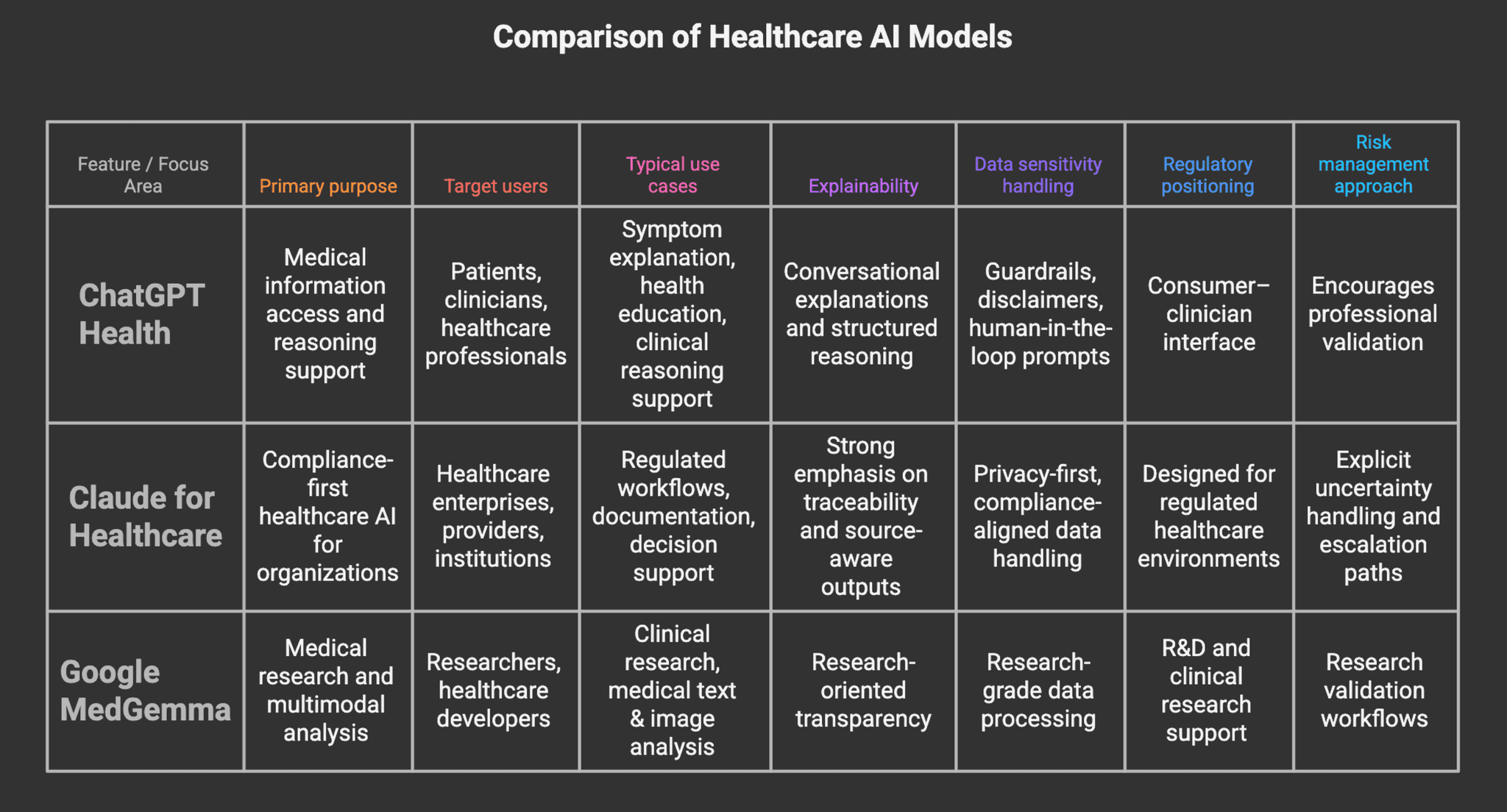
In summary:
ChatGPT Health targets patient-facing medical interaction.
Claude for Healthcare focuses on regulated enterprise workflows.
Google MedGemma supports research-driven medical AI applications.
Amazon Connect Health targets end-to-end patient operations and care coordination at the provider level.
What’s Really Changing in AI-Driven Healthcare?
AI is no longer just a backend optimization tool. It is becoming a direct interface between users and medical knowledge.
Unlike other industries, where AI primarily improves convenience or efficiency, healthcare AI directly influences decisions, trust, and human well-being.
Several key shifts are already visible:
- Accuracy and source transparency are critical when AI interprets medical information.
- Explainability is essential: users must understand why recommendations are made.
- Responsible AI must recognize uncertainty and defer to human expertise.
These are not abstract ideals. They are baseline requirements for any AI system operating in healthcare environments.
A Turning Point for Healthcare
Healthcare differs fundamentally from many other AI application domains:
- It is highly regulated, with strict expectations around data protection, safety, and outcomes.
- The cost of error is substantial: professionally, ethically, and socially.
- Users approach healthcare with heightened expectations for trust, sensitivity, and reliability.
As a result, successful AI in healthcare is not just about technical capability.
It is about building systems that are:
- accurate in interpretation,
- safe in delivery,
- compliant by design,
- and accountable in practice.
At ASSIST Software, this approach has long guided our healthcare work. Across our projects, human-centered design and regulatory alignment are prioritized—whether we are enhancing treatment adherence through digital therapeutics or supporting clinicians with real-world decision tools.
From Insight to Practice
Earlier this year, ASSIST Software was featured in Handelsblatt, Germany’s leading business newspaper, in an analysis exploring the role of digital platforms and AI in modern healthcare.
That article examined how AI-driven systems are not only improving patient outcomes but also strengthening healthcare system resilience amid workforce shortages, rising costs, and shifting patient expectations.
The coverage reinforces a critical insight:
AI becomes transformative only when it is responsibly integrated into real healthcare workflows.

How We Are Responding to the Rapid Adoption of AI in Healthcare
For ASSIST Software, 2025–2026 is not about observing AI trends from a distance. They are about building, testing, and deploying AI systems that can operate responsibly in real healthcare environments.
Designing AI for Regulated Healthcare Contexts
We design system architectures that prioritize data protection, explainability, and human oversight, ensuring alignment with healthcare regulations and operational realities.
Applying AI in Real Healthcare Projects
Through digital therapy platforms, treatment adherence solutions, healthcare operations tools, we translate AI capabilities into measurable, real-world impact.
Investing in AI Engineering Expertise
We continuously invest in our teams, tools, and infrastructure to support complex, health-centric AI systems—from early concept through production deployment.
Real Projects. Real Results
AI in healthcare is already being built, deployed, and evaluated in live environments. ASSIST Software has hands-on experience with solutions that illustrate both the potential and the complexity of this space:
HealthBeacon – A therapy management platform supporting structured care plans and treatment adherence through connected digital tools.
Autisma Therapy – A personalized support platform for children with autism, using adaptive learning pathways and context-aware interaction.
OR Manager – An intelligent scheduling solution that optimizes operating room planning and improves resource efficiency.
Each project reflects a thoughtful approach to digital health: grounded in real needs, aligned with compliance, and designed for measurable outcomes.
Why AI Can No Longer Be Treated as an Experiment
AI in healthcare is not a passing trend. It represents a strategic inflection point:
- Technology, ethics, and regulations are converging.
- User expectations are shifting toward AI-mediated intelligence.
- Healthcare organizations are under pressure to adapt quickly, but responsibly.
Organizations that invest now in understanding how AI integrates with healthcare workflows, standards, and user expectations will build a durable competitive advantage.
As this space evolves, ASSIST Software will continue sharing insights, lessons learned, and applied innovation from real healthcare projects.
What ASSIST Software Builds for AI-Driven Healthcare
ASSIST Software is a software development company with over 30 years of engineering experience, building AI systems for the healthcare industry that meet exactly the standard this shift demands: accurate, explainable, compliant by design, and built for the realities of regulated clinical environments.
As medical AI moves from general-purpose tools toward domain-specific systems, and as the stakes around trust, accountability, and data handling rise accordingly, the engineering work becomes more consequential, not less. This is also the context in which we build EHR platforms with AI insights, clinical decision support systems, telemedicine applications, medical imaging AI, and IoMT integrations: not as features to ship, but as infrastructure that healthcare organizations can depend on.
For organizations navigating that transition responsibly, explore ASSIST Software's healthcare AI capabilities or reach our team directly at hello@assist.ro.
ASSIST Software holds ISO/IEC 42001:2023 certification for Artificial Intelligence Management Systems, making it one of the first companies in Europe to do so. The certification confirms that AI development at ASSIST Software is governed by a recognized international framework covering risk management, transparency, accountability, and lifecycle management of AI systems.
Frequently asked questions
What is driving the shift toward domain-specific AI in healthcare?
Generic AI systems were not built for the constraints of medical environments. Healthcare is pushing the field toward domain-specific systems designed around safety, accountability, and clinical context, where regulatory compliance, explainability, and responsible handling of sensitive data are non-negotiable from the ground up.
Why does AI in healthcare require stricter accountability than in other industries?
Healthcare AI directly influences decisions that affect human well-being, making the cost of error substantial. Accuracy, explainability, and deference to human expertise are baseline requirements, not optional features, in any system operating in a clinical or regulated environment.
How is AI changing how patients and providers interact with medical information?
AI is shifting from a backend tool to a direct interface for symptom interpretation, treatment guidance, and clinical decision support. This raises new expectations around trust, transparency, and reliability that healthcare organizations must address as adoption accelerates.
How does ASSIST Software build AI systems for healthcare?
ASSIST Software designs healthcare AI with data protection, explainability, and regulatory alignment built in from the start. With delivered projects including HealthBeacon, Autisma Therapy, and OR Manager, and ISO 42001 certification as of 2026, the team builds systems that perform responsibly in real clinical environments.